
Choosing the Optimal Cooling Solution: Liquid vs Air
In the world of cutting-edge technology like AI and cloud services, traditional cooling systems are often pushed beyond their limits. As rack densities surge to between 500-1000kW in data centers, the demand for efficient cooling solutions rises. According to the Vertiv Data Center Trends 2025 report, it is crucial to implement advanced cooling methods to prevent costly equipment failures and downtime.
The Mechanics of Liquid Cooling vs. Air Cooling
Cooling systems are vital to maintaining the operational integrity of your data center. Equipment generates heat, and efficient cooling is necessary to avert overheating and potential shutdowns. Air cooling utilizes air to dissipate heat, making it suitable for environments with moderate density. This method employs systems like Liebert PDX Compact DX and Liebert CW Chilled Water to meet varied cooling needs.
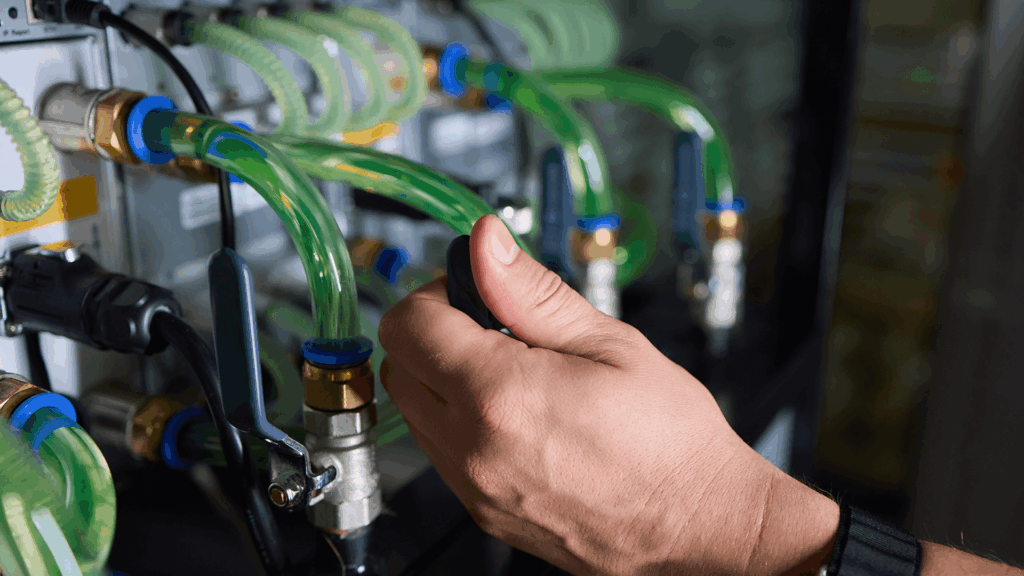
Conversely, liquid cooling uses fluids to directly manage heat. It circulates liquid through systems, drawing away heat more effectively than air. This method includes approaches like:
- Direct-to-chip cooling: Delivers coolant straight to server chips. Example: Vertiv™ CoolChip CDU
- Rear door heat exchangers: Mounts on server racks to dissipate heat. Example: Liebert® DCD Water-Cooled Rack Door
- Immersion cooling: Submerges servers in non-conductive liquid to absorb heat.
These liquid cooling methods handle high densities far more efficiently than air cooling.
Determining the Best Cooling Method for Your Data Center
Your data center’s cooling solution relies heavily on rack density. For racks under 20kW, air cooling is typically adequate due to lower power and heat output. Consider an air system like the Liebert DS Direct Expansion Cooling System to swap warm air for cool in your facility.
However, for racks demanding 20kW or more, liquid cooling becomes essential. At higher demands of 30kW and above, traditional air systems often fail to suffice due to limited heat transfer capabilities. A hybrid cooling approach, integrating both air and liquid systems, is often recommended to optimize heat management and efficiency.
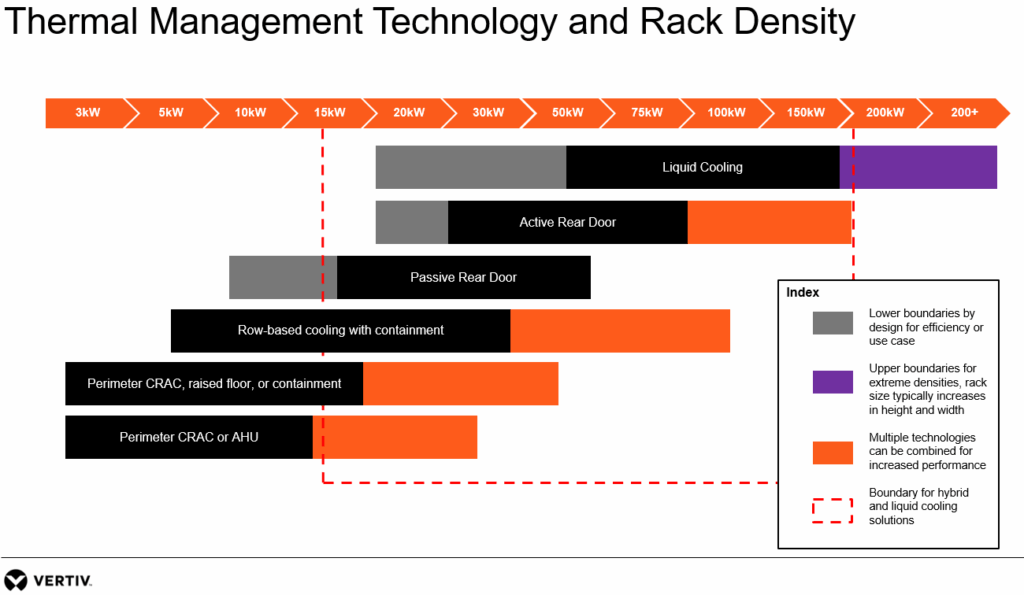
With advancements like AI increasing server densities, hybrid cooling systems are gaining popularity in data centers. Products such as the Vertiv™ CoolChip CDU are designed to implement this cooling strategy by sending coolants directly to chips while using AC to maintain ambient temperatures, thereby reducing energy consumption.
Explore Efficient Cooling Solutions
To create an optimized environment for your data center, it is crucial to consider factors beyond just temperature and humidity. Ensuring your setup is organized and up-to-date is key to maintaining smooth operations. Stay ahead of emerging technologies and trends by signing up for our newsletter. For personalized guidance on cooling solutions, contact Bud Griffin and Associates at 713.664.5462.
FAQs About Liquid Cooling
What is liquid cooling? Liquid cooling is a method that uses water or non-conductive liquids to efficiently remove heat from data center equipment.
How does liquid cooling compare to air cooling? Liquid cooling circulates fluids to absorb heat directly, making it more suitable for high-density environments than traditional air cooling, which uses air as a medium.
When should I consider liquid cooling over air cooling? Liquid cooling is recommended for data centers with racks consuming 20kW or more due to its superior efficiency in handling higher temperatures.
Can I use both liquid and air cooling? Yes, a hybrid approach combining both methods can maximize heat management, especially in high-density facilities.
Why is liquid cooling becoming more popular? As technology evolves, data centers require more efficient cooling methods like liquid cooling to handle increased density and prevent overheating.